PVC vs LSZH vs TPU : which jacket material for fiber cables in 2026 ?

Contents
Are you specifying or ordering fiber optic cables for an installation in a public-access building, a datacenter, a campus or an outdoor deployment ? The choice of outer jacket material is not secondary, it is strategic. It governs at once the cost, the long-term reliability, the CPR regulatory compliance and the post-incident costs.
Wrong choice ? Winter micro-cracks, rack corrosion after fire, CPR penalties, voided insurance. This guide compares PVC, LSZH and TPU across eight technical criteria, identifies the use cases where each one prevails, and presents Elfcam's certified solutions.
Why the jacket choice is strategic
The impact of materials manifests on three critical levels :
- Indirect optical performance : a poorly formulated jacket exerts radial stress on the fiber (micro-bending phenomenon), increasing insertion loss (in dB) and degrading the link's optical budget.
- Reliability in continuous installation : resistance to tension, crushing and repeated bending (pulling, winding, unwinding) is directly tied to the jacket choice. It determines the useful service life of the cable.
- Regulatory compliance and insurance risk : in regulated spaces, compliance with the CPR (Construction Products Regulation) with fire-reaction classifications (Cca, B2ca, Dca…) is a legal imperative. A non-compliant material leads to penalties, voided insurance and considerable post-incident costs.
The initial cost of a cable often represents less than 5% of the total cost of a fiber installation over 20 years. Saving 30% on the jacket by accepting non-compliant PVC can cost 1000% in post-incident repair.
PVC / LSZH / TPU comparison table
| Characteristic | PVC | LSZH | TPU |
|---|---|---|---|
| Chemical family | Chlorinated thermoplastic | Halogen-free compound (polyolefin base) | Thermoplastic elastomer (polyether/polyester) |
| Relative cost (PVC base = 1.0) | Base (1.0) | Medium to high (~1.5-2.0×) | High (~2.0-3.0×) |
| Fire safety | Opaque smoke + toxic gases (HCl) | Low opacity, zero corrosive gas | Self-extinguishing, but < LSZH |
| Mechanical strength | Moderate | Good (rigid) | Excellent / Superior |
| Abrasion resistance | Low | Good | Exceptional (5-20× PVC) |
| Low-temperature flexibility | Low (micro-cracks) | Acceptable | Very good down to -40 °C |
| UV / outdoor resistance | Low (accelerated ageing) | Moderate | Very good (weather) |
| Application areas | General unregulated indoor cabling | Public-access buildings, datacenters, tunnels, technical pathways, transport, confined environments | Tactical cables (military/broadcast), robotics, heavy industries |
1. Polyvinyl chloride (PVC)
PVC is historic and remains predominant in entry-level products. An economical option, but with significant technical and safety vulnerabilities in 2026 :
Structural defects and ageing
- Cold-induced micro-cracks (plasticizer loss) below 0 °C
- Accelerated UV ageing : yellowing, cracking
- Short outdoor service life (5-10 years vs 20-30 years for TPU)
Major post-fire impact
The release of hydrogen chloride (HCl), a very powerful acid, is not limited to immediate toxicity for occupants. It :
- Condenses into hydrochloric acid on contact with moisture
- Corrodes copper and surrounding precision electronics
- Can cause collateral damage in rooms far from the fire
- Generates post-incident costs for cleaning and replacement far higher than the initial cable price
CPR compliance : PVC banned in public-access buildings since 2017
Since July 2017, the Construction Products Regulation (CPR) imposes fire classifications (Cca, B2ca, Dca) in all Public-Access Buildings, technical pathways, tunnels, data centers and new buildings. Classic PVC no longer meets these requirements. Using PVC where LSZH is required exposes the installer and the project owner to penalties.
2. LSZH (Low Smoke Zero Halogen)
LSZH (low smoke emission, zero halogen) is the modern regulatory standard for indoor installations where service continuity and occupant safety come first.
Mechanism and CPR compliance
LSZH uses metal hydrates (alumina trihydrate, magnesium hydroxide) that release water vapor during combustion, slowing the fire and lowering the temperature. No halogen (chlorine, bromine, fluorine) → no corrosive gas.
It is the mandatory choice for the indoor jacket of :
- New buildings and major renovations
- Technical pathways and false ceilings
- Public-access buildings (hospitals, schools, offices, shops)
- Tunnels, underground car parks
- Datacenters and server rooms
Engineering constraints
Common criticism : the LSZH formulation (particularly for Cca and B2ca) is more rigid than PVC or TPU, and offers lower abrasion resistance than TPU. To be taken into account during :
- Pulling operations in narrow conduit
- Minimum bend radii to respect (typically 15× the diameter)
- Use in abrasive environments (prefer TPU)
3. TPU (Thermoplastic polyurethane)
TPU is the high mechanical performance material for extreme, industrial or tactical environments.
Quantified performance
- Abrasion resistance : 5 to 20× that of PVC
- Service temperatures : -40 °C to +80 °C without degradation
- Tensile strength : > 30 MPa
- Elasticity : 600-800% elongation at break
- Chemical resistance : oils, fuels, industrial solvents
Repeated bending (cycling)
Its high elasticity makes TPU perfect for :
- Industrial robotics : articulated arms, production lines
- "reel-in/reel-out" deployment systems (repeated winding/unwinding)
- Military tactical cables deployed and recovered several times
- Broadcast : filming cables and temporary installations
Limits to know
- Significantly higher cost (2-3× PVC, 1.5× LSZH)
- Fire behavior inferior to LSZH — self-extinguishing but not CPR B2ca/Cca compliant
- Surface sensitive to superficial scratches (does not affect structural integrity)
- Unsuitable for public-access buildings (prefer LSZH for regulated indoor use)
TPU does not replace LSZH : it complements it. LSZH for regulated indoor cabling, TPU for mechanically aggressive environments and the open air.
Elfcam solutions : LSZH and TPU
Certified LSZH compliance
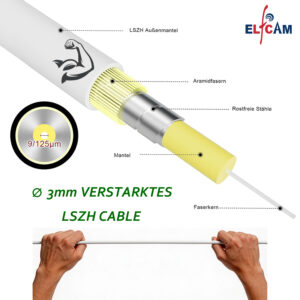
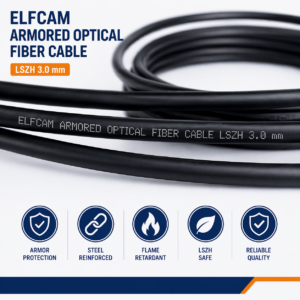
The majority of Elfcam indoor fiber optic cables are designed according to LSZH principles : low smoke emission, absence of corrosive acid gases, CPR compliance. Our certifications (CE, RoHS, REACH) are publicly accessible.
TPU range for rugged applications
For projects requiring maximum mechanical resilience, Elfcam develops a range of field cables and tactical cables with TPU jacket. Specifically dimensioned to guarantee communication continuity in aggressive environments (military, heavy industrial, temporary deployment, broadcast).
Elfcam LSZH range
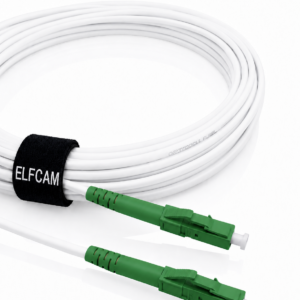
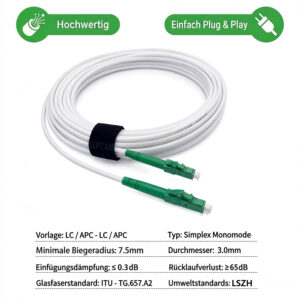
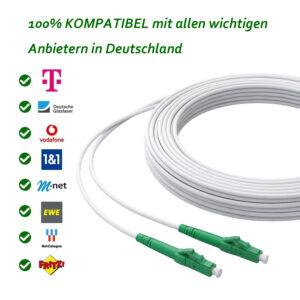
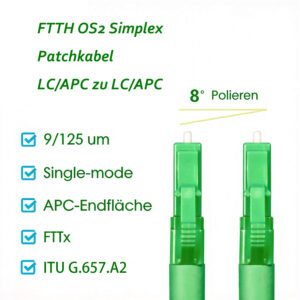
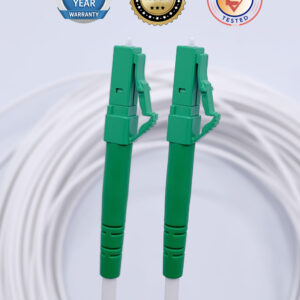
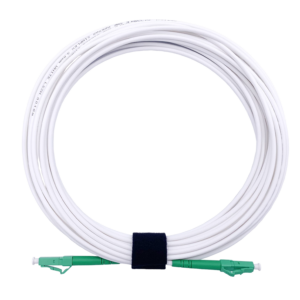
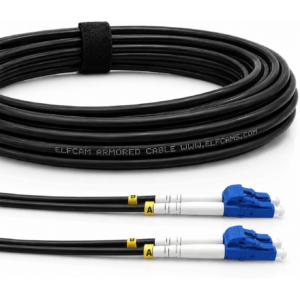
- Single-mode LC/APC LSZH white patch cord — office, datacenter, patch panel
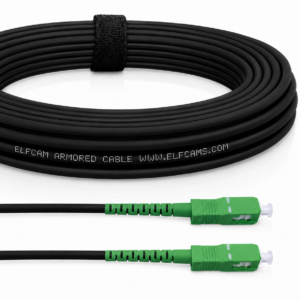
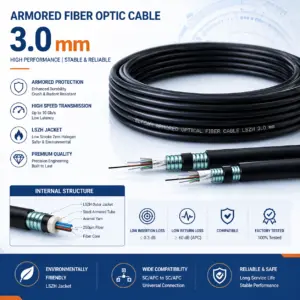
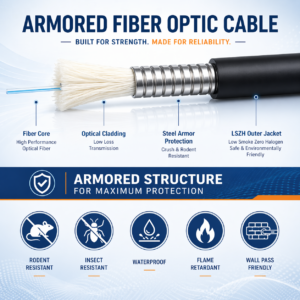
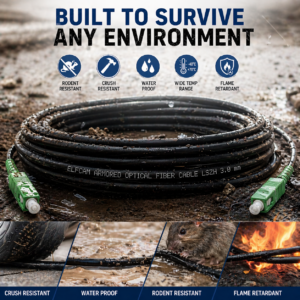
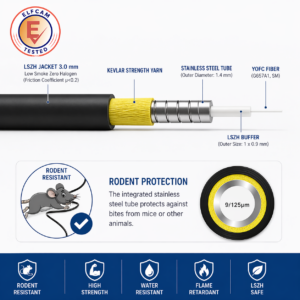
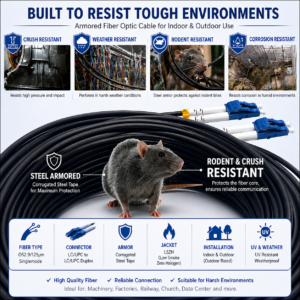
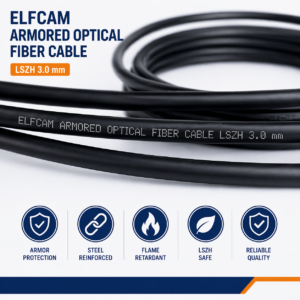
- Steel-armored single-mode SC/APC LSZH cable — reinforced technical pathway
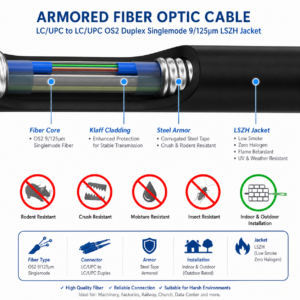
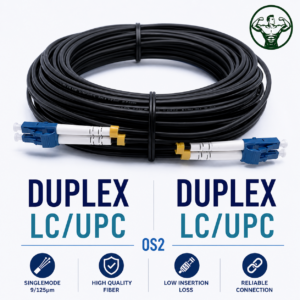
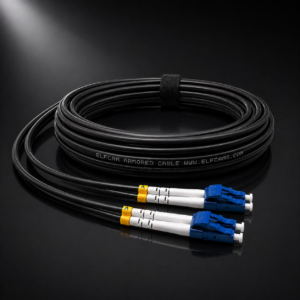
- Steel-armored LC/UPC ext/int OS2 LSZH cable — mixed outdoor/indoor
- Loose structure 250 µm single-mode OS2 LSZH cable — professional deployment
- SC/APC OS2 LSZH patch cords x20 (several colors) — bundles for integrators
- Reinforced outdoor cables — ADSS, armored jacket

CE / RoHS / REACH certifications
All our compliance documents and certifications are accessible on our dedicated page : Elfcam Certifications.
How to choose ?
| Installation context | Recommended material | Why |
|---|---|---|
| Non-public-access home, indoor cabling | LSZH (or PVC) | LSZH for occupant safety, moderate cost |
| Public-access building, pro office, hotel | LSZH mandatory | CPR Cca/B2ca compliance |
| Datacenter, server room | LSZH mandatory | Electronics protection + CPR |
| Tunnel, underground car park | LSZH Cca | Evacuation time + visibility |
| Sheltered outdoor | Steel-armored LSZH or outdoor | UV + mechanical protection |
| Weather-exposed outdoor | TPU or specific outdoor jacket | UV + extreme temperatures |
| Robotics, production line | TPU | Repeated bending, abrasion |
| Military, broadcast, tactical | TPU | Repeated deployment, aggressive environment |
| Tight budget, temporary non-public-access | PVC tolerated | Minimum cost, short-term use |
Pro tip : don't mix without thought
For the same cabling, favor jacket consistency. Mixing PVC and LSZH in the same bundle loses the CPR advantage of LSZH (PVC smoke mixes with LSZH gases). Likewise, an outdoor TPU lead followed by an indoor LSZH requires a transition in a watertight enclosure. Simpler : all LSZH for indoor, all TPU for exposed outdoor, certified ext/int cables for transitions.
FAQ — PVC vs LSZH vs TPU
1Is PVC still legal in 2026 ?
- Banned in public-access buildings, technical pathways, tunnels, datacenters (CPR requirement)
- Tolerated in private non-public-access domestic cabling, in internal equipment patching, in temporary connections
- Used massively in imported low-cost products — check the datasheet before buying
2What does "Cca classification" mean on my cables ?
- Aca : non-combustible (almost impossible for a cable)
- B1ca, B2ca : very low fire contribution — tunnel, critical datacenter
- Cca : limited contribution — public-access buildings, technical pathways
- Dca : acceptable contribution — standard office
- Eca : minor contribution — domestic
- Fca : no performance evaluated
3TPU or LSZH for a garden ?
- Sheltered spot (under eaves, not directly exposed) : LSZH OK
- Direct UV + weather exposure : TPU or specific "outdoor" cable
- Buried run : reinforced outdoor cable (ADSS, PE jacket) — better than TPU when buried
4Is LSZH really 100% halogen-free ?
5Micro-bending : is it really a problem ?
6How much does an LSZH vs PVC cable cost ?
- PVC : 2-4 €
- LSZH : 3-6 € (+50-100%)
- TPU : 6-12 € (+200-400%)
7How to verify a cable's compliance ?
- Physical marking on the jacket (CPR class, standard reference)
- Declaration of Performance (DoP) provided by the manufacturer
- Datasheet with IEC 60332 (fire resistance), IEC 61034 (opacity), IEC 60754 (halogens) tests
- Traceable batch number
8Elfcam delivery and certifications ?
In summary
The fiber jacket choice comes down to :
- PVC : economical, tolerated in non-public-access domestic use, but dangerous post-fire. Avoid in 2026.
- LSZH : modern indoor standard. Mandatory in public-access buildings, datacenter, tunnel, technical pathway. CPR Cca compliance or better.
- TPU : extreme mechanical performance. For robotics, tactical, broadcast, heavy industrial, exposed outdoor.
For most projects, LSZH is the right compromise (reasonable cost, full compliance, safety). Invest in TPU only when the environment demands it. Consult our range of Elfcam fiber cables certified LSZH and our compliance documents to dimension your installation.