CPE : what is Customer Premises Equipment ?
Contents
When ordering an internet subscription or deploying a professional network, you will hear about a CPE. A vague acronym : is it a box ? a router ? a mobile repeater ? And how is it different from an FTTH ONU or an HGU ?
The problem comes from the evolution of usage : 20 years ago, the CPE referred only to an ADSL modem. Today, the same term covers fibre boxes, 4G/5G routers, HGUs, industrial gateways and VoIP IADs. This guide describes what a CPE really is, the product families, and how to choose between a 4G/5G CPE, a fibre ONU or a WiFi 6 router depending on your situation.
What is a CPE ?
CPE stands for Customer Premises Equipment, literally "equipment on the customer's premises". It is a generic term that refers to any device installed at the user's premises (individual or business) at the end of an operator network.
More precisely, a CPE :
- Is managed by the user (or by the operator via TR-069)
- Converts the operator signal (fibre, coaxial, 4G/5G, satellite) into a LAN signal usable by devices (Ethernet, WiFi)
- Often integrates a router, WiFi, a firewall, LAN ports
- Can repeat mobile signals (4G/5G) and rebroadcast them over WiFi
In French commercial language, a CPE most often refers to a 4G or 5G router that lets you connect to the Internet via mobile network rather than via fibre or ADSL.
Difference between ONU and CPE
Both are client-side devices, but they handle different signals :
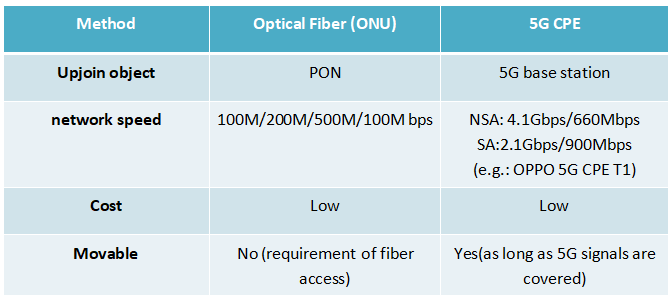
| Criterion | ONU / ONT | 4G/5G CPE |
|---|---|---|
| Incoming signal type | Optical fibre (PON) | 4G/5G radio waves |
| Connector | SC/APC or LC/APC | SIM card + antennas |
| Typical throughput | 500 Mbps - 10 Gbps | 50 Mbps - 1 Gbps (5G) |
| Latency | 1-5 ms | 20-50 ms |
| Installation | Optical termination outlet | Plug & play with SIM |
| Mobility | Fixed | Semi-mobile (depending on plan) |
| Typical use | Residential FTTH | Poorly covered areas, nomadic use |
In short : all ONUs are CPEs in the broad sense (client-side devices), but not all CPEs are ONUs. The CPE is an umbrella term, ONU/ONT a specific category linked to PON.
Types of CPE : consumer, commercial, industrial
1. Consumer CPE
Intended for families, home offices and small businesses. Typical characteristics :
- Support for 4G LTE Cat 4/6/12 and/or 5G NSA/SA
- Dual-band WiFi (2.4 + 5 GHz), 160 MHz bands
- 2-4 Gigabit LAN ports
- SIM slot (even dual-SIM)
- Internal or external antennas
Use cases : second home, ADSL white zone, temporary replacement for a faulty fibre box, motorhome / converted van.
2. Commercial CPE
Designed for SMEs and multi-user offices :
- Higher throughput : 5G SA with carrier aggregation
- QoS management to prioritise VoIP and critical apps
- Built-in VPNs (IPSec, OpenVPN)
- SIM/Ethernet redundancy (failover)
- Management API (Zabbix, Grafana, SNMP)
3. Industrial CPE
Intended for machine-to-machine (M2M) connectivity and industrial IoT :
- IP65/IP67 waterproof, temperature -40/+75 °C
- Serial interfaces (RS232, RS485), GPIO, relays
- Support for industrial 5G R15 NSA/SA
- Mounts for pole, mast, ceiling, DIN rail
- Environmental certifications (CE, ATEX depending on zone)
Industrial CPE vs outdoor WiFi 6 AP
To cover a garden, car park or warehouse with WiFi, an outdoor IP67 WiFi 6 access point is often more suitable and cheaper than an industrial CPE. The industrial CPE becomes relevant as soon as you need a native 5G uplink and serial ports (PLCs, industrial sensors).
4G/5G CPE : for poorly covered areas
The main reason to use a 4G/5G CPE :
- Fibre is not yet available at your location
- ADSL is too slow (less than 30 Mbps)
- The phone has good signal (4G/5G reaches where the fixed box does not)
- You are in a temporary rental or mobile dwelling
A 4G/5G CPE amplifies the mobile signal considerably compared to a smartphone :
- Higher-gain external antennas (6-10 dBi vs 1-2 dBi for a smartphone)
- Maximum permitted transmission power
- Ability to connect external MIMO antennas aimed at the relay antenna
- Second-hop function : receives weak signals better and redistributes them over a more robust local WiFi
With a good 5G CPE and a directional antenna, throughputs of 200-500 Mbps are common in semi-rural areas — often better than the local ADSL.
Industrial 5G CPE
The industrial 5G CPE serves two main uses :
1. Extend private 5G coverage
In Industry 4.0 (factories, ports, construction sites), a private 5G network covers the site. Industrial CPEs act as relays between the 5G base station and the terminals (sensors, AGVs, robots). They offer :
- Latency < 10 ms
- Dedicated bandwidth (5G slicing)
- Enhanced security (VPN, VLAN segmentation)
2. WAN gateway for remote sites
In wind turbines, photovoltaics, pipelines and charging stations, the industrial CPE acts as a cellular gateway to relay data. It is an advantageous replacement for a fibre link that is costly to install at an isolated site.
For a professional network combining fibre and wireless, our fibre to Ethernet converters and PoE switches are the ideal complement to a 5G gateway with outdoor IP67 WiFi 6 access points.
Complementary Elfcam equipment
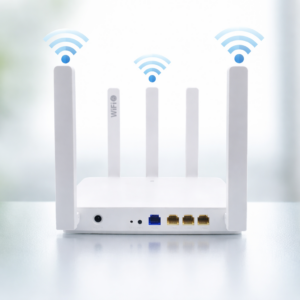
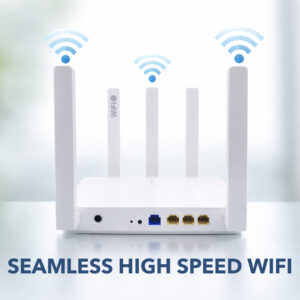
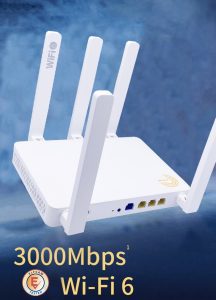
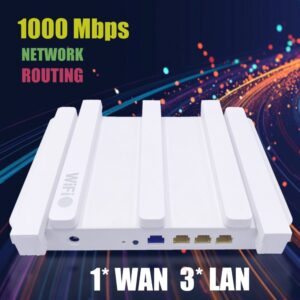
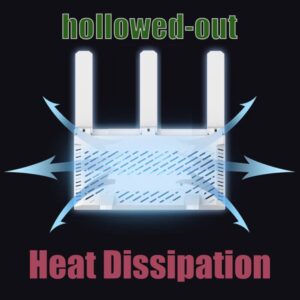
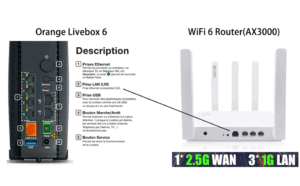
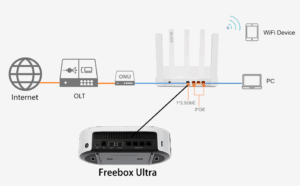
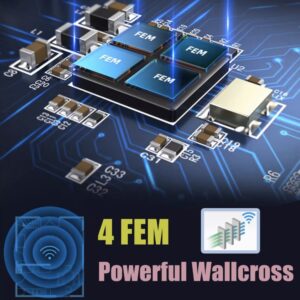
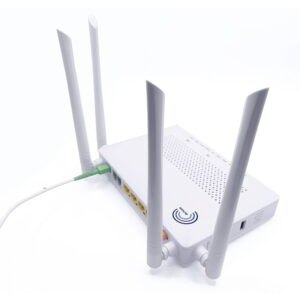
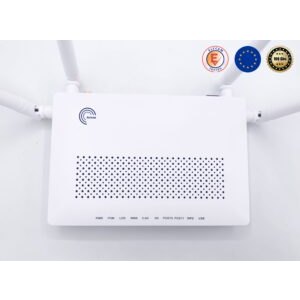
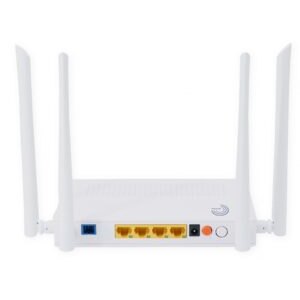
- WiFi 6 Mesh Router AX3000 — wired CPE behind your fibre box
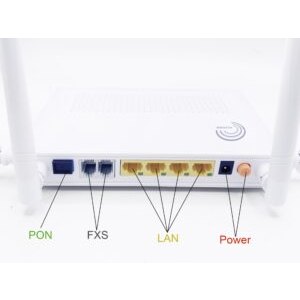
- HGU V-SOL WiFi 6 FTTH — replaces an operator fibre box
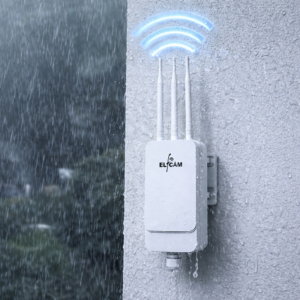
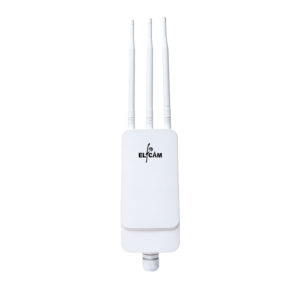
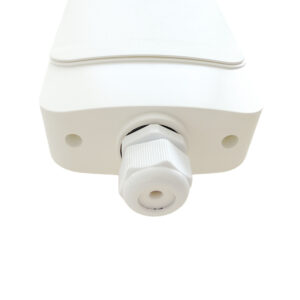
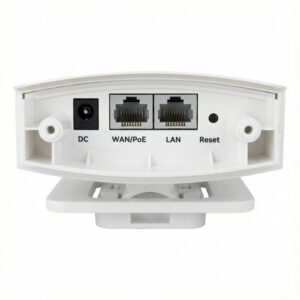
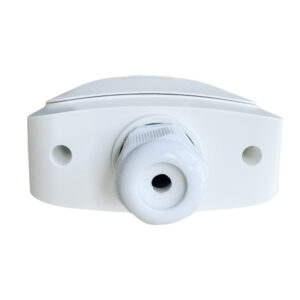
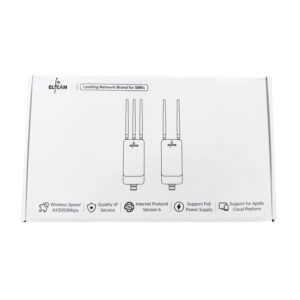
- Outdoor IP67 WiFi 6 access point — extends the coverage of a mobile CPE
- Fibre to Ethernet converters — to connect a CPE to a fibre backbone
- PoE switches — power cameras and APs from the CPE
How to choose your CPE ?
- Do you have eligible fibre ? If so → HGU or ONT, not a 4G/5G CPE
- Mobile coverage ? Check on monreseaumobile.arcep.fr. You need at least 3-4 bars of 4G indoors
- Desired throughput ? For > 200 Mbps, aim for a 5G SA CPE. For 50-150 Mbps, a 4G Cat 6-12 CPE is enough
- Number of simultaneous users ? Up to 10 devices, a consumer CPE is enough. Beyond that, a commercial CPE
- Indoor or outdoor installation ? Outdoor → CPE with an IP65+ rating and steerable antennas
- Budget : consumer 100-300 €, commercial 300-600 €, industrial 500-2000 €
FAQ — Everything about the CPE
1Is my operator fibre box a CPE ?
2Can a 4G/5G CPE replace my fibre box ?
3What are the best 5G CPEs in 2026 ?
4Unlimited data SIM card for a CPE ?
5Is an external antenna mandatory ?
6Can an industrial CPE be used for home use ?
7CPE or cellular repeater ?
- CPE : converts 4G/5G into WiFi (new network)
- Cellular repeater : amplifies the 4G/5G signal directly for smartphones (direct mobile network)
8Elfcam accessories to complement a CPE ?
In summary
The CPE is an umbrella term that covers all client-side equipment : fibre box, 4G/5G router, HGU, industrial gateways. In commercial language, it mainly refers to 4G/5G routers as an alternative to fibre.
For home use with eligible fibre, go for an FTTH HGU or a WiFi 6 mesh router. In a white zone, opt for a 5G SA CPE. For an industrial site, combine an industrial 5G CPE with fibre converters and outdoor APs.